The term “soft tissue surgery” can sound incredibly broad, and finding out your pet requires a procedure can naturally cause anxiety. Simply put, soft tissue surgery encompasses any surgical intervention that does not involve bones, joints, ligaments (which fall under orthopedics), or the nervous system (neurosurgery).
This diverse category of medicine is handled with extreme precision, utilizing advanced technology and highly personalized anesthesia protocols. When your pet faces a complex soft tissue procedure, seeking the expertise of a board-certified veterinary surgeon (Diplomate of the American College of Veterinary Surgeons – DACVS) ensures they benefit from advanced training, specialized surgical suites, and meticulous clinical standards.
When is soft tissue surgery needed?
Because soft tissue covers almost everything outside the skeletal and nervous systems, these surgeries address a wide array of vital organ, skin, and respiratory conditions.
- Skin and Subcutaneous Masses: Pets frequently develop lumps, bumps, or deep tissue masses. While some are benign, others require oncological surgery. A specialized surgeon is critical for cancerous mass removals, as the surgeon must plan appropriate and sometimes wide surgical margins to ensure complete removal of cancerous cells. In some cases, special reconstructive techniques are needed to close the skin properly following the removal of large masses or those in more challenging locations.
- Gastrointestinal Obstructions and Disease: Curious pets often swallow non-food items—such as toys, socks, or peach pits—resulting in life-threatening intestinal blockages. ). Intestinal masses (benign or malignant cancers) can also cause obstructions requiring removal of a portion of intestines. Additionally, some large-breed dogs are prone to Gastric Dilatation-Volvulus (GDV), a severe stomach twist that requires emergency untwisting and surgical gastropexy (tacking the stomach to the abdominal wall).
- Urogenital and Urinary Tract Issues: Pets can develop painful urinary stones that block the urethra, irritate the bladder wall, and/or predispose to urinary tract infections, requiring surgical removal. Unspayed female pets are also at risk for pyometra, a severe, life-threatening bacterial uterine infection that requires immediate emergency surgical extraction of the uterus.
- Respiratory and Airway Disorders: Flat-faced (brachycephalic) breeds like Bulldogs, Pugs, and French Bulldogs often suffer from Brachycephalic Obstructive Airway Syndrome (BOAS). Corrective surgery is needed to widen narrow nostrils and shorten elongated soft palates to restore normal breathing. Additionally, older large-breed dogs can suffer from laryngeal paralysis, requiring a surgical laryngeal “tie-back” procedure to improve breathing and oxygenation.
- Chronic Ear and Throat Conditions: Dogs with severe, chronic, end-stage ear infections can experience permanent calcification of their ear canals. In these painful cases, a specialized surgeon can perform an advanced procedure to remove the diseased ear canal entirely, eliminating chronic pain and infection.
- Masses of the Liver and Spleen: Dogs, and less frequently cats, unfortunately commonly suffer from cancer of the liver and spleen. Cancer in either organ can pose life-threatening bleeding and surgical removal is typically the recommended treatment to obtain a definitive diagnosis and provide the best short- and long-term survival time.
How board-certified veterinary surgeons diagnose soft tissue conditions.
Before your pet ever enters an operating suite, their surgical path is meticulously planned using state-of-the-art diagnostics. Surgery is never a guessing game; it is a highly targeted intervention mapped out through precise internal imaging and cellular analysis.
Cellular and tissue analysis.
- Fine Needle Aspirate (FNA): A quick, minimally invasive test in which a tiny needle collects cells from a mass, AKA needle biopsy. The cells are examined under a microscope to determine if the lump is inflammatory, benign, or malignant.
- Biopsy: For some larger or deeply situated internal masses, a small tissue sample is surgically collected and sent to a veterinary pathologist for histopathology. This step is crucial for planning the exact margins needed during a tumor removal.
Advanced diagnostic imaging.
- Digital Radiography (X-rays): Quick, high-resolution views used to locate dense foreign objects, assess organ size, and identify fluid accumulations.
- High-Resolution Ultrasound: Real-time imaging that allows radiologists and surgeons to inspect the internal architecture of abdominal organs (such as the liver, spleen, kidneys, and bladder) and check for subtle abnormalities or fluid/blood flow issues.
- Computed Tomography (CT) Scans: Creating highly detailed, 3D cross-sections of your pet’s body, CT scans are essential for planning complex tumor removals near major blood vessels or mapping out narrow respiratory passages.
- Pre-Operative Bloodwork: Comprehensive profiles check values such as liver and kidney function, red blood cell counts, and clotting times to identify and help address any concerns to improve safety and success of surgery and anesthesia for your pet.
Specialized soft tissue procedures at BluePearl Pet Hospital.
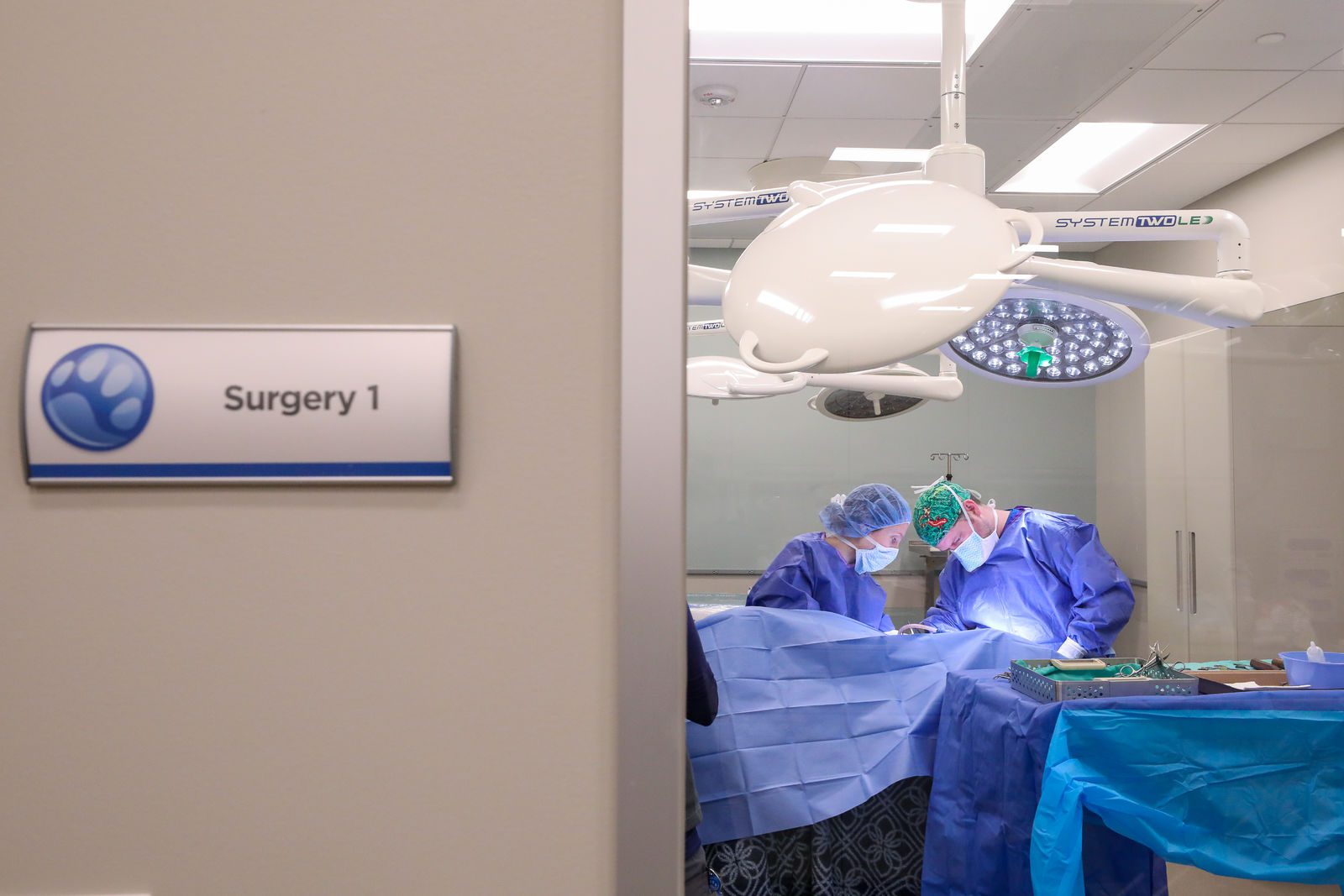
BluePearl Pet Hospitals are uniquely equipped with state-of-the-art operating suites, advanced monitoring equipment, and highly trained anesthesia technicians to perform complex soft tissue surgeries. Some BluePearl hospitals also have full-time or consulting anesthesiologists.
- Mass Removals (Oncological & Reconstructive Surgery): Removing tumors with precision, utilizing skin grafts or reconstructive techniques for large or complex wound closures.
- Cystotomy (Bladder Stone Removal): Surgically opening the bladder to safely retrieve painful stones, followed by a thorough flushing of the urinary tract.
- Foreign Body Gastrointestinal Surgeries: Performing gastrotomies (opening the stomach) or enterotomies (opening the intestines), or intestinal resection and anastomosis (removal and reattachment) when the affected portion is not healthy/viable, to remove life-threatening blockages.
- BOAS Corrective Surgery: Improving breathing and oxygenation in flat-faced breeds (Bulldogs, Pugs) by widening stenotic (narrow) nares (nostrils) and shortening an elongated soft palate.
- Total Ear Canal Ablation (TECA): A specialized procedure for pets with chronic, painful ear disease, removing the diseased ear canal to relieve pain and eliminate infection.
- Perineal Urethrostomy (PU): Creating a permanent new urinary opening, primarily for male cats suffering from recurrent, life-threatening urinary blockages.
Caring for your pet after soft tissue surgery.
When you bring your pet home, managing their post-operative recovery requires dedication. Your commitment to the recommended discharge instructions directly influences how quickly and cleanly their incisions heal.
Hospitalization vs. same-day discharge.
While minor mass removals may allow your pet to go home the same day, major abdominal, thoracic, or airway surgeries benefit from overnight observation. Many of BluePearl’s 24-hour monitoring wards ensure your pet’s pain is continuously controlled, their vitals remain stable, and their initial healing is closely monitored by professional emergency and critical care nursing staff.
The golden rules of home recovery.
- Strict Confinement: Your pet must be kept in a small, quiet space (a crate, recovery pen, or dedicated small room with no jumpable furniture) for 2 weeks. Running, jumping, or playing can stretch the healing skin, causing the incision to pull apart (incisional dehiscence).
- Consistent Recovery Collar Use: The Elizabethan collar (“cone”) must remain on your pet at all times. Pets lick to soothe irritation, but their mouths carry bacteria that can rapidly cause surgical site infections. Chewing/biting sutures can also cause incisional opening.
- Managing Pain and Medications: Administer all prescribed medications exactly on schedule. Modern post-op care utilizes a customized, multi-modal pain management schedule (including anti-inflammatories, nerve blocks, other pain medications, and mild sedatives if needed) to keep your pet calm and comfortable.
- Daily Incision Inspections: Check the incision twice daily. Mild pinkness and slight swelling are normal signs of active healing. However, if you notice active bleeding, any discharge, missing sutures, separated skin edges, or a foul odor, contact your veterinary team immediately.
Soft tissue surgery FAQ.
- What is considered soft tissue surgery on a dog or cat? Soft tissue surgery refers to any surgical procedure that does not involve bones, joints, cartilage (orthopedics), or the nervous system (neurosurgery). It includes surgeries on the skin (such as mass removals), the gastrointestinal tract (removing foreign bodies), the urinary system (bladder stone removal), spleen and liver, and the respiratory system (airway adjustments). At specialized hospitals like BluePearl, these procedures are performed by board-certified specialists with advanced training in delicate internal organ operations.
- How long is the recovery timeline after pet soft tissue surgery? Most soft tissue surgical incisions heal within 10 to 14 days, which is when external sutures or staples are typically removed. However, complete internal tissue healing can take anywhere from 4 to 8 weeks depending on the operated tissue and the complexity of the procedure. During the first two weeks, strict activity restriction and the use of a recovery collar are absolutely critical to prevent complications.
- Why is my pet referred to a board-certified veterinary surgeon for soft tissue surgery? While primary care veterinarians are highly skilled in routine surgeries, board-certified veterinary surgeons have completed an intensive four-year residency program entirely dedicated to surgery and have passed rigorous board examinations. For complex procedures—such as tumor removals near vital structures, airway and chest surgery, or abdominal surgeries—a specialist brings an extra level of expertise, specialized equipment, and advanced surgical techniques that maximize chances for a positive outcome.
- How is pain managed during and after my pet’s soft tissue surgery? Modern veterinary medicine uses a customized “multi-modal” pain management strategy, combining several types of medications that target pain pathways from different angles. This includes local anesthetic blocks during the procedure, intravenous pain medications during hospitalization, and structured oral medications (such as non-steroidal anti-inflammatories and targeted nerve medications) for you to administer at home.
Need a soft tissue surgery consultation with one of our veterinary surgeons? Find a BluePearl Pet Hospital near you.